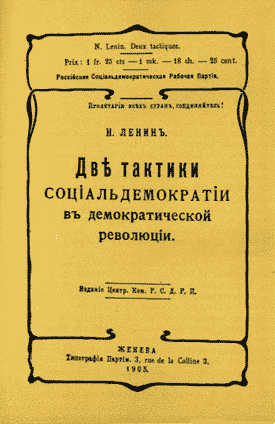
In a revolutionary period it is very difficult to keep abreast of events, which provide an astonishing amount of new material for an evaluation of the tactical slogans of revolutionary parties. The present pamphlet was written before the Odessa events.[1] We have already pointed out in the Proletary[4] (No. 9—“Revolution Teaches”)[2] that these events have forced even those Social-Democrats who created the “uprising-as-a-process” theory and who rejected propaganda for a provisional revolutionary government actually to pass over, or begin to pass over, to the side of their opponents. Revolution undoubtedly teaches with a rapidity and thoroughness which appear incredible in peaceful periods of political development. And, what is particularly important, it teaches not only the leaders, but the masses as well.
There is not the slightest doubt that the revolution will teach social-democratism to the masses of the workers in Russia. The revolution will confirm the program and tactics of Social-Democracy in actual practice, by demonstrating the true nature of the various classes of society, by demonstrating the bourgeois character of our democracy and the real aspirations of the peasantry, who, while being revolutionary in the bourgeois-democratic sense, harbour not the idea of “socialisation,” but of a new class struggle between the peasant bourgeoisie and the rural proletariat. The old illusions of the old Narodism, which are so clearly visible, for instance, in the draft programme of the “Socialist-Revolutionary Party”[5] on the question of the development of capitalism in Russia, the question of the democratic character of our “society” and the question of the significance of a complete victory of a peasant uprising—all these illusions will be mercilessly and completely blown to the winds by the revolution. For the first time it will give the various classes their real political baptism. These classes will emerge from the revolution with a definite political physiognomy, for they will have revealed themselves, not only in the programs and tactical slogans of their ideologists, but also in the open political action of the masses.
Undoubtedly, the revolution will teach us, and will teach the masses of the people. But the question that now confronts a militant political party is: shall we be able to teach the revolution anything? shall we be able to make use of the correctness of our Social-Democratic doctrine, of our bond with the only thoroughly revolutionary class, the proletariat, to put a proletarian imprint on the revolution, to carry the revolution to a real and decisive victory, not in word but indeed, and to paralyse the instability, half-heartedness and treachery of the democratic bourgeoisie?
It is to this end that we must direct all our efforts, and the achievement of it will depend, on the one hand, on the accuracy of our appraisal of the political situation, on the correctness of our tactical slogans, and, on the other hand, on whether these slogans will be backed by the real fighting strength of the masses of the workers. All the usual, regular, current work of all the organisations and groups of our Party, the work of propaganda, agitation and organisation, is directed towards strengthening and expanding the ties with the masses. This work is always necessary; but in a revolutionary period less than in any other can it be considered sufficient. At such a time the working class feels an instinctive urge for open revolutionary action, and we must learn to set the aims of this action correctly, and then make these aims as widely known and understood as possible. It must not be forgotten that the current pessimism about our ties with the masses very often serves as a screen for bourgeois ideas regarding the role of the proletariat in the revolution. Undoubtedly, we still have a great deal to do to educate and organise the working class; but the whole question now is: where should the main political emphasis in this work of education and of organisation be placed? On the trade unions and legally existing societies, or on armed insurrection, on the work of creating a revolutionary army and a revolutionary government? Both serve to educate and organise the working class. Both are, of course, necessary. But the whole question now, in the present revolution, amounts to this: what is to be emphasised in the work of educating and organising the working class, the former or the latter?
The outcome of the revolution depends on whether the working class will play the part of a subsidiary to the bourgeoisie, a subsidiary that is powerful in the force of its onslaught against the autocracy but impotent politically, or whether it will play the part of leader of the people’s revolution. The more intelligent representatives of the bourgeoisie are perfectly aware of this. That is precisely why the Osvobozhdeniye[6] praises Akimovism, Economism in Social-Democracy, the trend, which is now placing the trade unions and the legally existing societies in the forefront. That is precisely why Mr. Struve welcomes (in the Osvobozhdeniye, No. 72) the Akimovist trends in the principles of the new Iskra. That is why he comes down so heavily on the detested revolutionary narrowness of the decisions of the Third Congress of the Russian Social-Democratic Labour Party.
It is exceptionally important at the present time for Social-Democracy to have correct tactical slogans for leading the masses. There is nothing more dangerous in a revolutionary period than belittling the importance of tactical slogans that are sound in principle. For example, the [Menshevik] Iskra[7] in No. 104, actually passes over to the side of its opponents in the Social-Democratic movement, and yet, at the same time, disparages the importance of slogans and tactical decisions that are in front of the times and indicate the path along which the movement is proceeding, with a number of failures, errors, etc. On the contrary, the working out of correct tactical decisions is of immense importance for a party which, in the spirit of the sound principles of Marxism, desires to lead the proletariat and not merely to drag at the tail of events. In the resolutions of the Third Congress of the Russian Social-Democratic Labour Partyand of the Conference of the section which has seceded from the Party,[3] we have the most precise, most carefully thought-out, and most complete expression of tactical views—views not casually expressed by individual writers, but accepted by the responsible representatives of the Social-Democratic proletariat. Our Party is in advance of all the others, for it has a precise program, accepted by all. It must also set the other parties an example of strict adherence to its tactical resolutions, in contradistinction to the opportunism of the democratic bourgeoisie of the Osvobozhdeniye and the revolutionary phrase-mongering of the Socialist-Revolutionaries, who only during the revolution suddenly thought of coming for ward with a “draft” of a program and of investigating for the first time whether it is a bourgeois revolution that is going on in front of their eyes.
That is why we think it a most urgent task of the revolutionary Social-Democrats to study carefully the tactical resolutions of the Third Congress of the Russian Social-Democratic Labour Party and of the Conference, to define what deviations there are in them from the principles of Marxism, and to get a clear understanding of the concrete tasks of the Social-Democratic proletariat in a democratic revolution. It is to this task that the present pamphlet is devoted. The testing of our tactics from the standpoint ofthe principles of Marxism and of the lessons of the revolution is also necessary for those who really desire to pave the way for unity of tactics as a basis for the future complete unity of the whole Russian Social-Democratic Labour Party, and not to confine themselves solely to verbal admonitions.
N. Lenin
July 1905
[1] The reference is to the mutiny on the armoured cruiser Potemkin.[8] (Author’s note to the 1907 edition.–Ed.) —Lenin
[2] See p. 148 of this volume.–Ed.—Lenin
[3] The Third Congress of the Russian Social-Democratic Labour Party (held in London in May 1905) was attended only by Bolsheviks, while in the “Conference” (held in Geneva at the same time) only Mensheviks participated. In the present pamphlet the latter are frequently referred to as “new Iskra-ists” because while continuing to publish the Iskra they declared, through their then adherent, Trotsky, that there was a gulf between the old and the new Iskra. (Author’s note to the 1907 edition.–Ed.) —Lenin
[8] The mutiny on the armoured cruiser Potemkin. The mutiny broke out on June 14 (27), 1905. The crew brought the warship to the Port of Odessa, where a general strike was in progress. However, the favourable conditions that had arisen for joint action by the Odessa workers and the sailors of the Potemkin were not utilised. Numerous arrests of its members had weakened the Odessa Bolshevik organisation and it lacked unity. The Mensheviks were opposed to an armed uprising and held the workers and sailors back from taking offensive action. The tsarist government ordered the entire Black Sea Fleet to crush the Potemkin, but the crews refused to open fire on the cruiser. The officers were compelled to withdraw their ships. After eleven days of cruising in the Black Sea the crew of the Potemkin were forced by shortage of food and coal to take their vessel to a Rumanian port and surrender to the authorities. Most of the sailors remained abroad. Those who returned to Russia were arrested and court-martialled.
The Potemkin mutiny was unsuccessful, but the fact that the crew of a big naval vessel had joined the revolution marked an important stage in the development of the struggle against the autocracy. Lenin called it “the attempt to form the nucleus of a revolutionary army” (see present edition, Vol. 8, p. 562).
[4] Proletary (The Proletarian)—the name of an illegal Bolshevik weekly, official organ of the R.S.D.L.P. It was founded in accordance with a resolution of the Third Congress of the Party. Lenin was appointed editor-in-chief of Proletary by a decision of a plenary meeting of the Party’s Central Committee, on April 27 (May 10), 1905.
Proletary was published in Geneva from May 14 (27) till November 12 (25), 1905, a total of twenty-six issues being brought out. Active in the work of the editorial board were V. Vorovsky, A. Lunacharsky, and M. Olminsky. Proletary continued the policy of the old, Leninist Iskra, and maintained full continuity with the Bolshevik newspaper Vperyod.
In all, Lenin wrote about 90 articles and items for Proletary his articles being reprinted in local Bolshevik periodicals, and also published in the form of leaflets.
Publication of Proletary was discontinued shortly after Lenin’s departure for Russia in November 1905, the last two issues (Nos. 25 and 26) being edited by V. Vorovsky.
[5] The Party of Socialist-Revolutionaries—the Socialist-Revolutionaries (S.R.s) was the name by which a petty-bourgeois party in Russia was known. It came into being in late 1901 and early 1902 as a result of the merging of various Narodnik groups and circles, such as The Union of Socialist-Revolutionaries, the Party of Socialist-Revolutionaries, etc. Its views found official expression in the newspaper Revolutsionnaya Rossiya (Revolutionary Russia), published between the years 1900 and 1905, and the journal Vestnik Russkoi Revolutsii (Herald of the Russian Revolution)—1901-05. The S.R.s saw no class distinctions between the proletarian and the petty proprietor, glossed over the class stratification and the contradictions within the peasantry, and rejected the proletariat’s guiding role in the revolution. Their views were an eclectic mixture of the ideas of Narodism and revisionism. As Lenin put it, they tried to mend “the rents in the Narodnik ideas” with “bits of fashionable opportunist ‘criticism’ of Marxism” (see p. 310 of this volume). Advocated by the S.R.s as the chief method of struggle against the autocracy, the tactic of individual terrorism was greatly detrimental to the revolutionary movement, and hampered organisation of the masses for the revolutionary struggle.
The agrarian programme of the Socialist-Revolutionaries envisaged the abolition of private ownership of the land, which was to be transferred to the village commune on the basis of the labour principle and equalitarian tenure, and also the development of co-operatives. There was nothing socialist in this programme, which the S.R.s termed “socialisation of the land”, since, as Lenin pointed out, the preservation of commodity production and private farming of communal land cannot do away with the domination of capital, or rid the working peasantry of exploitation and impoverishment. Neither can co-operatives be the salvation of the small peasant in conditions of capitalism, for they serve only to enrich the rural bourgeoisie. At the same time, the demand for equalitarian tenure of the land, though not socialist in character, was, as Lenin pointed out, of progressive, revolutionary-democratic significance, inasmuch as it was spearheaded against landlordism.
The Bolshevik Party unmasked the S.R.s’ attempts to pass themselves off as socialists, waged an unrelenting struggle against them for influence over the peasantry, and revealed the injurious effects of their tactic of individual terrorism on the working-class movement. At the same time, on certain conditions, the Bolsheviks entered into temporary agreements with the Socialist-Revolutionaries for the struggle against tsarism.
The absence of class homogeneity in the peasantry was the reason of the political and ideological instability in the SocialistRevolutionary Party, and of its constant vacillation between the liberal bourgeoisie and the proletariat. During the first Russian revolution there was a split in the Socialist-Revolutionary Party, its Right wing forming the legal “Toilers’ Popular Socialist Party”, whose views were close to those of the ConstitutionalDemocrats (Cadets), and the Left wing, taking shape as the semi-anarchist league of “Maximalists”. During the period of the Stolypin reaction, the Socialist-Revolutionary Party underwent a complete breakdown in respect of ideology and organisation, and during the First World War most of its members took a social-chauvinistic stand.
Following the victory of the February bourgeois-democratic revolution of 1917, the Socialist-Revolutionaries together with the Mensheviks and the Constitutional-Democrats, were the mainstay of the counter-revolutionary bourgeois-landlord Provisional Government, such leaders of the party as Kerensky, Avksentyev and Chernov becoming members of that government. The Socialist-Revolutionary Party discontinued its support of the peasants’ demand that landlord ownership of the land be abolished, on the contrary it came out for maintenance of that ownership, the S.R. members of the Provisional Government authorising punitive action against peasants who had seized land belonging to landlords.
Late in November 1917, the Left wing of the S.R. Party formed an independent party of Left Socialist-Revolutionaries, who in an effort to preserve their influence among the peasant masses, formally recognised Soviet rule and entered into an agreement with the Bolsheviks. However, they soon began a struggle against the Soviets.
During the years of foreign intervention and civil war, the S.R.s carried on counter-revolutionary, subversive work, gave active support to the interventionists and White generals, took part in counter-revolutionary plots, and organised terroristic acts against leaders of the Soviet state and the Communist Party. After the conclusion of the Civil War the S.R.s continued their hostile anti-Soviet acts within the country and in the camp of the White émigrés.
[6] Osvobozhdeniye (Emancipation)—a fortnightly journal published abroad from June 18 (July 1), 1902 until October 5 (18), 1905, under the editorship of P. Struve. Mouthpiece of the Russian liberal bourgeoisie, it consistently expressed the ideas of moderate monarchist liberalism. In 1903 the Osvobozhdeniye League developed around the journal, taking definite shape in January 1904, and existing until October 1905.
Together with the Zemstvo constitutionalists, the Osvobozhdeniye group formed the nucleus of the Constitutional-Democratic Party (Cadets) which came into being in October 1905, and became the chief party of the liberal monarchist bourgeoisie in Russia.
[7] The reference is to the new, Menshevik Iskra. Following the Second Congress of the R.S.D.L.P. the Mensheviks gained control of Iskra, with the connivance of Plekhanov, and from November 1903, beginning with number 52, Iskra became the organ of the Mensheviks. It came out until October 1905.
| | | An Urgent Political Question | |
| Document Index | ||
| < Backwards | Forwards > | |||||
| Works Index | | | Volume 9 | | | Collected Works | | | L.I.A. Index |